Pencel Turns Business Outcomes Into Agentic Workflows That Run Reliably
Bo Wang, Founder and CEO
Press Release
Pencel connects the systems a business already runs on, learns how that business operates, and turns recurring processes into governed AI workflows owners can trust. Pencel is building the AI operating system, the "AI Brain" that runs your business and makes your company an intelligent, self-learning system.
TL;DR
- What it is. A desktop AI operations system that connects the software a company already runs on, learns how that company works, and turns its recurring processes into agentic workflows that can run unattended.
- The problem. Models get smarter every month, but companies can't convert that into outcomes: their systems are fragmented, the AI doesn't know their business, agent behavior isn't governed by company policy, and the tools are built for engineers.
- How it works. You describe an outcome in business language. Pencel's agentic compiler turns it into an explicit plan naming which systems the agent may touch, which steps it must complete, and where it must stop for a human. You approve that plan once; every run executes inside it and leaves an evidence record.
- Where it is. Private beta, with six design partners across logistics, RFP response, strategy, reporting, and finance operations. Request access to join.
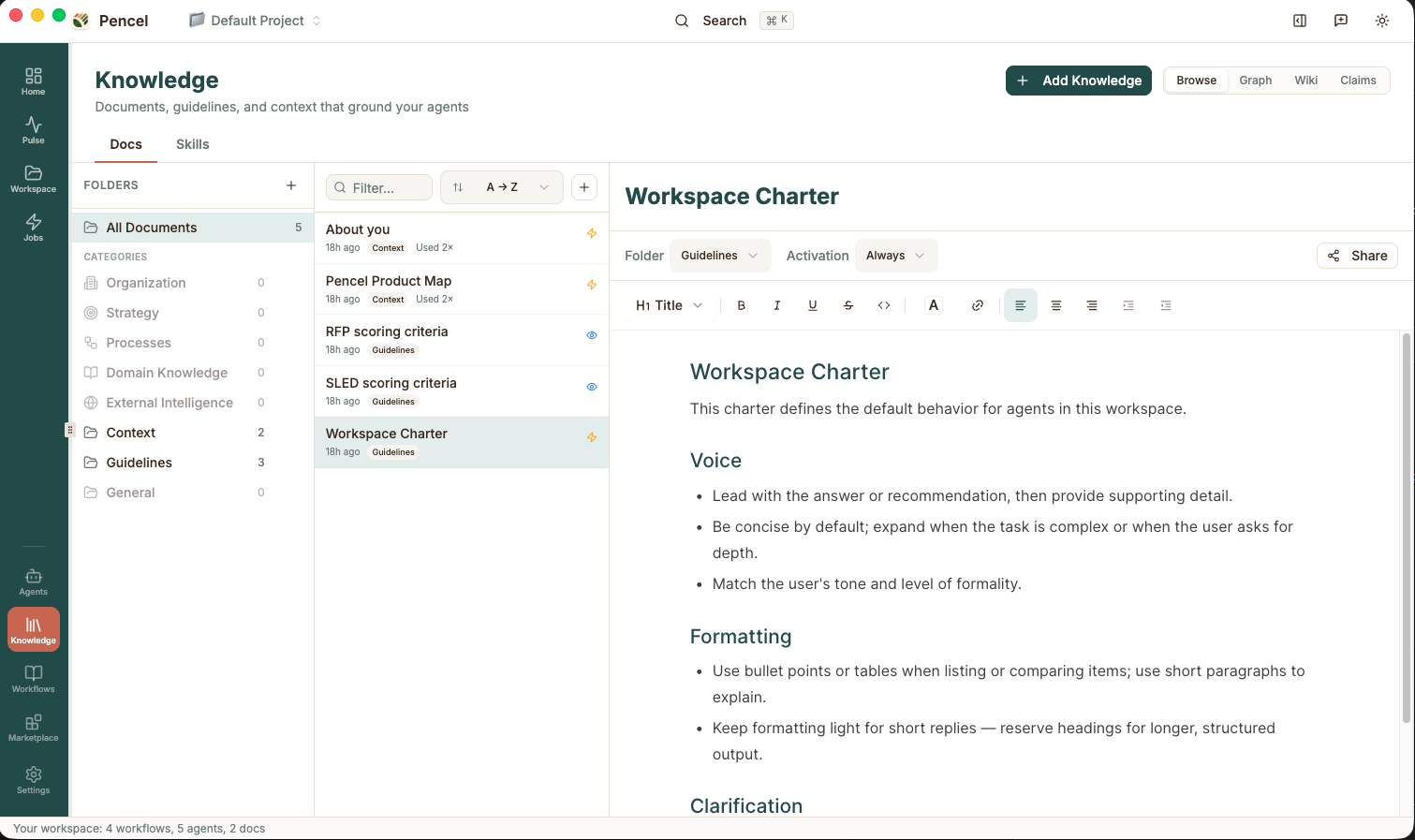
SEATTLE, August 1, 2026 — Pencel today launched an AI operations system for companies that want AI to get real work done inside their own environment. Pencel curates a company's unique context and standard operating procedures (SOPs), so AI understands how the business runs. Business owners juggle too many disconnected tools. Pencel unifies the information scattered across CRM, ERP, accounting, logistics, and internal communication systems, then lets non-technical users turn daily routines into workflows. Built on the world's first AI compiler for workflow development and orchestration, Pencel is designed for trust, reliability, and ease of use. Every workflow runs inside permissions the company sets, pauses for human approval where required, and leaves an auditable record. Pencel turns a business into an AI-native company that moves faster and adapts quicker.
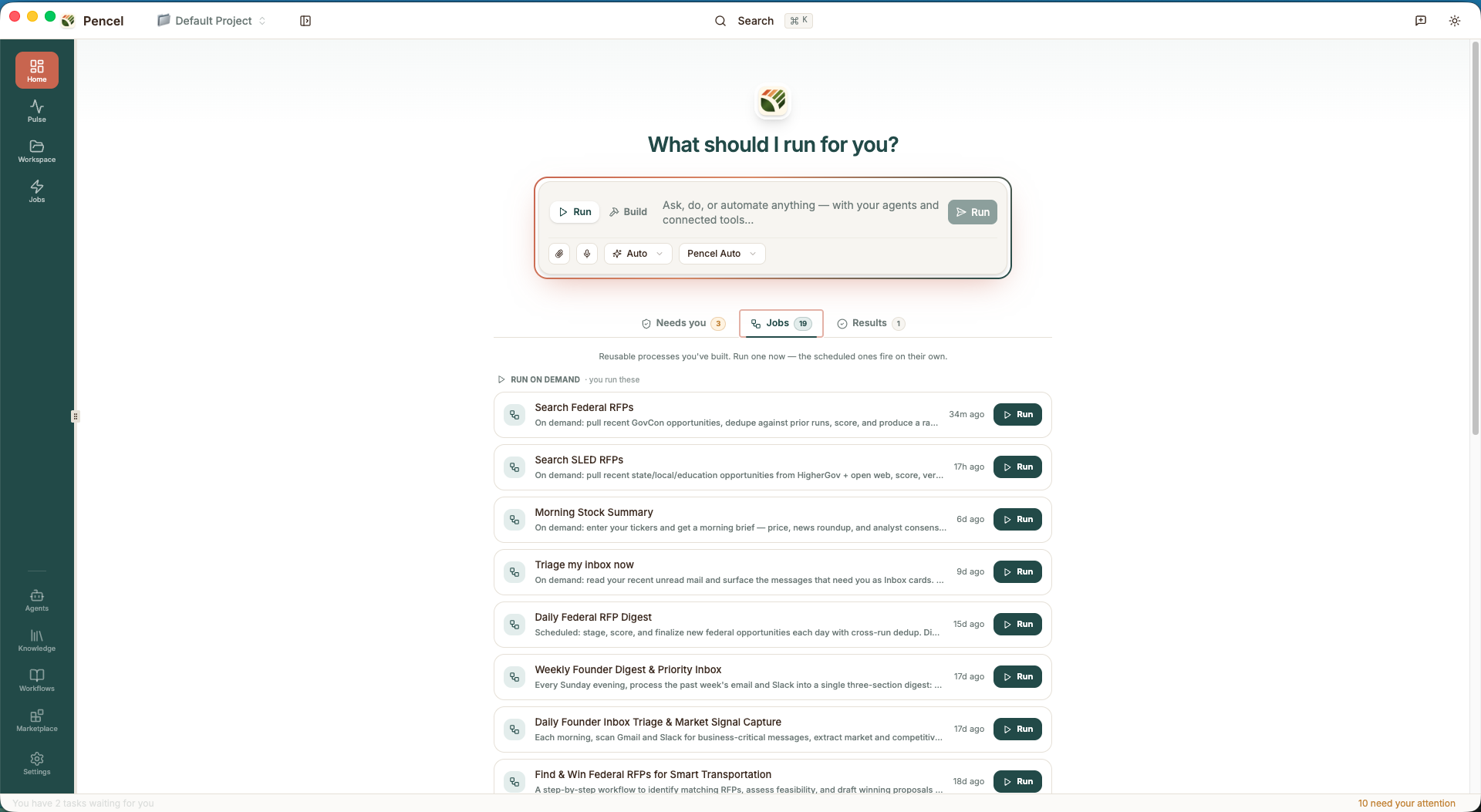
Customer Problem
AI capabilities have grown rapidly every month, but companies still struggle to turn AI intelligence and tokens into productivity and outcomes. Four challenges stand between an enterprise and the full value of today's models:
Fragmented Software: Most growing companies don't lack software. They own too much software that doesn't work together. Sales information lives in a CRM, financial records in accounting software, operating details in industry-specific systems, and company procedures on employees' laptops. People fill the gaps themselves, holding the pieces in their heads and stitching information together by hand. The same problem repeats at every company, every day, draining productivity and slowing both operations and decision making.
Missing Business Context: Most companies use the same underlying models. What differentiates one company from another is its own knowledge, standard operating procedures (SOPs), and decision-making processes. A general AI assistant does not know a company's products, policies, priorities, procedures, pricing rules, or past decisions unless the user supplies that context every time. The work is to curate what a company uniquely knows and connect it to the models effectively, so the answer is tailored and relevant to that business instead of generic.
Agentic Behavior Is Neither Reliable Nor Governed by Company Policy: Traditional Robotic Process Automation (RPA) is reliable but hard to build and too rigid for ambiguity. AI agents make judgments, but their non-deterministic behavior is hard to trust when the stakes are high. And trust takes more than a right answer: observability into what a run did, traceability from output back to source, and governance deciding in advance what an agent may touch and where it must stop. Most agent products offer a chat transcript and little else, so companies choose between automation that can't think and intelligence they can't govern.
Ease of Use for Business Users: Nearly every agent product on the market is built for someone who already understands prompts, skills, tools, harnesses, and evals. Business users should not have to learn how an agent works to get an agent to work. They do not want to build and operate agents in a terminal. They want an intuitive interface where they interact with the outcome, reviewing it, correcting it, and approving it, rather than climbing the learning curve of agent mechanics.
The Solution
Pencel first connects the systems and knowledge a company already uses, then turns them into a shared foundation for AI-powered work. A company keeps its CRM, accounting software, document system, and industry applications as the systems of record. Pencel coordinates work across them through secure, permissioned, one-click integrations. The company also gives Pencel the operating context each workflow needs: procedures, product information, customer escalations, and compliance policies. On top of these systems of record, Pencel builds a system of intelligence, a semantic and reasoning layer that understands the business.
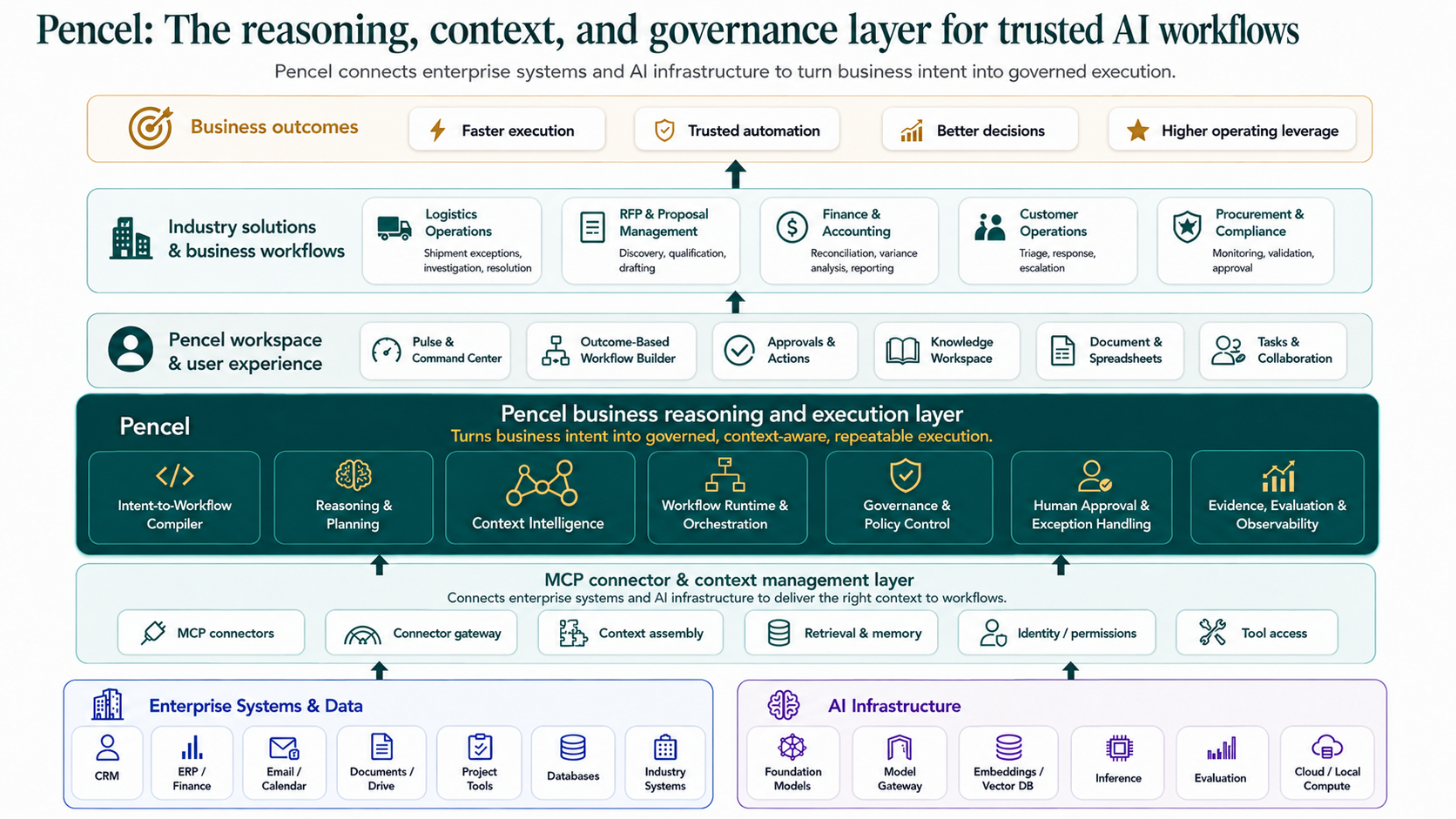
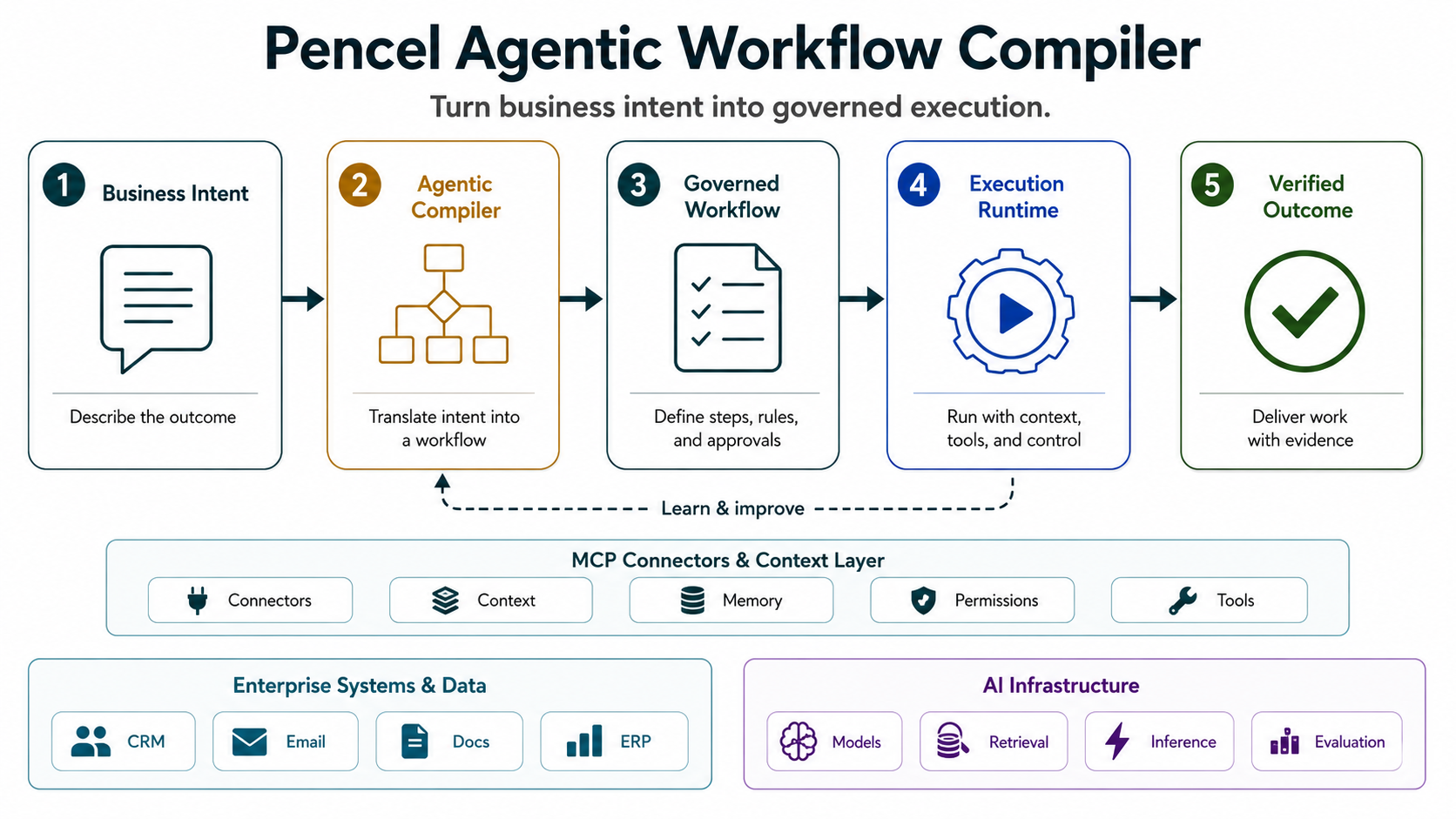
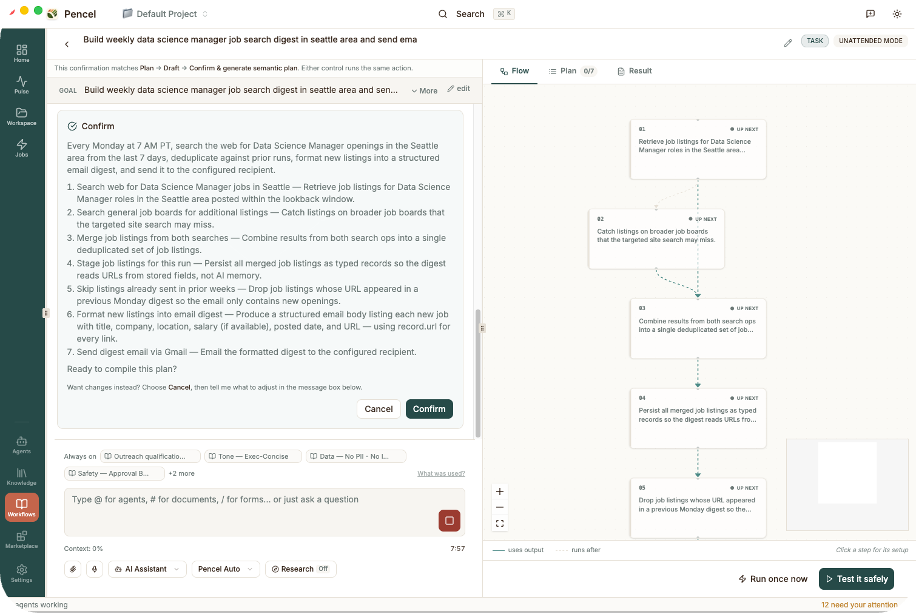
A business user starts with the outcome, not the agent technology. Building an agent normally demands a steep learning curve to make it behave properly and safely, which can be intimidating for business users. Pencel removes the burden entirely. Through a collaborative, interactive conversation, Pencel gathers the desired outcome and requirements. Pencel developed an AI-compiler-based agentic workflow runtime that translates them into a structured workflow defining which systems the agent may access, which steps it must complete, and where human approval is required. The compiled plan gives the agent clear instructions, tools, and policies, so it stays in its lane during execution. Pencel is working with an AI startup as a design partner to help them find the right RFPs and respond to them quickly. The workflow monitors procurement sources, evaluates each opportunity against the company's qualification criteria, and prepares a proposal from approved materials. When the workflow hits a judgment call or an exception, it stops and asks. The user focuses on the outcome and reviews the quality of the results, and Pencel does the rest.
Users review results in Pulse, Pencel's personalized operations feed. Pulse works like a chief of staff, continuously preparing the information and decisions most relevant to each user. Each card represents the result of a workflow the user created or approved. It explains what happened and stages the next action. An email card, for example, includes a response drafted from the company's context and the user's writing preferences. This closed loop is a Pencel design tenet: every piece of information should be actionable, not just nice to know. Pencel's built-in memory system learns from every user action and saves the important signals, so answers and workflows get better and more personalized with use.
The Pencel agentic system is not only for personal productivity. It is built for teams. Users share workflows, knowledge, and agents with colleagues, all governed by access controls, so a routine workflow keeps running even when its owner is on vacation. Teams can share SOPs and compliance policies in one place and use them to onboard new members quickly and retain knowledge through employee attrition.
Pencel builds control, transparency, and security into every step, so a business can run workflows with peace of mind. The customer decides what each workflow may access, what actions it may take, and where human approval is required. A company can require review before Pencel sends an external message, changes a financial record, or takes any other high-impact action. Each run creates an evidence record showing which sources Pencel consulted, which tools it used, which actions it took, and which outputs it produced.
Design Partner Program
Pencel is working with six design partners to automate their business operations. Together they cover logistics operations, RFP discovery and response, strategy planning, business reporting, and finance operations workflows. The pattern across all of them is the same: a recurring process that matters, that involves judgment, and that no one had been able to automate because the existing options were either too rigid to handle the judgment or too unsupervised to trust with it.
"We believe the next generation of companies will run on an AI-native operating layer that connects people, knowledge, and work, and that layer keeps learning and gets better every week it's used," said Bo Wang, founder and CEO of Pencel. "I have experienced firsthand how AI transformed the developer experience, a 10x productivity gain if not more, but there is still a lack of good agentic tools for a business audience. The core problem is less about technical tooling and more about helping business users gain trust in the outcome an agent produces. We are building the trust mechanism between agents and users in the AI era."
Getting Started
Pencel is in private beta. Individuals can request access at pencel.ai to join as a beta tester. Once you receive your invitation code, it unlocks the download at pencel.ai/download.
For companies, Pencel is running a design-partner program with early customers in logistics, fintech, and AI. Design partners receive hands-on support and workflows built around their business. Contact partners@pencel.ai to join.
Frequently Asked Questions
What can I do with Pencel, concretely?
Pencel is a desktop application for macOS and Windows. Your workspace lives on your machine: your workflows, your knowledge, your run history, your memory. Inside it, you can:
Build agentic workflows in plain language. Describe the outcome you want. Pencel asks the questions it needs, then compiles your intent into an explicit workflow wired to your company's systems and context. No canvas of nodes, no prompt engineering.
Get work done in chat, not just talked about. You can chat with Pencel like any assistant, but the conversation can also act: pull the record, draft the reply, update the sheet, file the document, and schedule your routine tasks.
Run your to-dos and communications from one feed. Pulse is Pencel's operations feed, working like a chief of staff. Each card is the result of a workflow, explaining what happened and staging the next action, so your morning starts with decisions to make instead of systems to check.
Work on documents, spreadsheets, and slides in natural language. Pencel has a built-in workspace for documents, reports, spreadsheets, and HTML slide decks. Ask for the edit and review the result, instead of hand-editing every cell and bullet.
Build your own agents without code. Give an agent its purpose, its knowledge, and the tools it may use. Pencel handles the rest.
Install ready-made solutions from the Marketplace in one click. Solution packs ship working workflows for a specific job, such as federal RFP discovery or inbox triage, that run against your systems immediately and can be edited afterward.
Let it learn your company continuously. Pencel's memory records what you accept, reject, and edit, so answers and workflows get more accurate and more personalized every week.
Connect your systems in one click. Integrations are built on the Model Context Protocol, so the set keeps growing. Today that includes Google Workspace and Gmail, Slack, Notion, GitHub, Stripe, QuickBooks, Linear, Atlassian, Asana, web search and scraping, and direct database connections including PostgreSQL and SQLite, plus your local filesystem. Internal and industry-specific systems connect through custom MCP servers.
Every one of these runs inside permissions you set, pauses where you require approval, and leaves an evidence record of which sources were consulted, which tools ran, and what was produced.
How is it different from other AI and automation products?
There are excellent products in this space, and we are not going to tell you which features they do or don't have. What we can tell you is what Pencel optimizes for, because that is the real difference. Pencel is built end to end for the business user's agentic work experience, and six things follow from that choice.
Ease of use is the constraint, not a nice-to-have. You never see a prompt, a tool schema, a harness, or an eval. You describe an outcome in business language and review a plan written the same way. If a business user has to learn what an agent is to get their Monday report automated, we consider that our bug.
Your company's knowledge is a managed asset. Pencel gives your SOPs, product details, pricing rules, policies, and past decisions a real home: organized, versioned, shareable, and set to activate where they matter. That knowledge grounds every agent automatically, instead of being pasted into a chat box each morning by whoever remembers.
Agents and knowledge are team objects, not personal ones. Workflows, knowledge, and agents can be shared with colleagues under access controls. A recurring workflow keeps running when the person who built it is on vacation. One employee's undocumented process becomes something the team owns, which is also what makes onboarding faster and attrition less expensive.
Operational workflows get built without code. The kind of multi-step, multi-system automation you would otherwise build in a node editor gets built here by describing it. And because the underlying steps are explicit rather than improvised, they behave predictably run after run.
Observability and governance are built in, not bolted on. Every run leaves an evidence record: which sources were consulted, which tools ran, which actions were taken, what was produced. Permissions bound what each workflow can reach. Approval gates stop consequential actions for a human. This is the part that decides whether a company can actually let a workflow run unattended.
The interface adapts to the workflow you built. Pencel generates the UI for your workflow rather than making you live in a generic chat window or a fixed form. Review a draft where a draft belongs, approve a decision where a decision belongs, see a table where a table belongs.
The short version: most products in this category are strongest for the person who can read a transcript and tune a config. Pencel is built for the person who owns the business outcome and needs to trust the result.
What is the agentic compiler, and why does it matter?
It is what makes an agent safe enough to leave running unattended.
Every agent product has to answer one question: what stops this thing from doing something you didn't want? Most answers are a version of "a human watches it." Pencel's answer is to decide the boundary before the run starts, by compiling business intent into a governed workflow in five steps.
1. Capture intent as a plan, not a prompt. A conversation with you produces a structured semantic plan: the outcome, the operations, the criteria, and the requirements. This is an intermediate representation the product can inspect, not a paragraph of instructions the model has to interpret.
2. Ground every operation in something real. Each operation is resolved against the live catalog of tools and connections in your workspace. A step that cannot be bound to a real tool, or that needs a credential you have not connected, does not become a hopeful instruction. It becomes a question we ask you.
3. Wire the data flow. The compiler derives how records move between steps, which field identifies a record, where results have to be staged, and how a deduplicating workflow closes its loop so tomorrow's run doesn't re-report today's results.
4. Validate before anything runs. The plan is checked against a body of invariants: the step graph is acyclic and free of forward references, every required input is actually wired to a reachable source, output and input shapes are compatible, external-send and other consequential steps carry the right approval policy, and credentials exist. Contradictions surface here, at compile time, rather than halfway through a live run against your production systems.
5. Emit a governed plan the runtime enforces. The output is a schema-validated physical plan carrying a per-step risk level, approval gates, and a content hash identifying exactly what you approved. At execution time the runtime checks reality against it: a consequential action on a connection outside the approved set is refused, an unattended external send to an unexpected recipient is stopped, and every run writes an evidence record of sources consulted, tools used, and actions taken.
How this differs from ReAct and loop engineering. A ReAct-style agent often does draft a plan first, and a good one can be quite a reasonable plan. The difference is what that plan is. It is a piece of text the model wrote for itself, and nothing checks it or binds the run to it. The tools it names may not exist in your workspace, the data it assumes may not be reachable, and the model is free to depart from it on step three without anything noticing. Loop engineering, context engineering, and better tool descriptions all improve the odds, but the constraint still lives inside the model's reasoning, where it cannot be verified in advance or enforced during the run.
A compiled plan is a checked artifact rather than a written intention. Its tools were resolved against your actual workspace, its data flow was validated, its approval gates were decided before you approved it, and the runtime measures the live run against it. The agent still reasons, and still handles the ambiguity that makes the work worth automating, but what it may reach and where it must stop were settled before the first token. That is the difference between an agent you supervise and an agent you can schedule.
How do I work with us?
Join the private beta. Pencel is invitation-only today. Request access and we will send you an invitation code, which unlocks the download and lets you build your first workflow. The free plan is the full local desktop experience with your own API keys, no credit card. See pricing for managed plans.
Become a design partner. Pencel is running a design-partner program with early customers in logistics, fintech, and AI. Design partners get hands-on support and workflows built around their actual operations, and direct influence over the roadmap. Company size is not a filter; a clear recurring process is. Contact partners@pencel.ai.
Invest. If you invest in AI infrastructure or vertical AI applications and want to talk about where the agentic operating layer for business goes next, reach Bo Wang directly at bo@pencel.ai.